We banged out a definition of social media a while ago, and it was quite well-received:
What actually IS social media? Liking this definition. With venn diagram http://t.co/2jovKdPUS8 via @referralcandy
— Ally Steele (@Ally_S) October 3, 2013
Our favourite response was a very interesting question we got from @edrethink:
@ReferralCandy Is it media gone social? Or is it social relationships gamified and made into self-publishing?
— John Spencer (@edrethink) September 30, 2013
It's a great question. Let's explore it.
"Media gone social" sounds plausible, but it's completely backwards. "Old media" would never have "gone social".
- They had no incentive to! They literally owned the most important channels through which most humans received most of their information. This was why they could afford to charge so much for advertising.
- "Going social" sounds straightforward today, when it was anything but. To "go social" by themselves at the time would've required a ridiculous, unjustifiable investment. That would mean diverting resources away from battling with competitors, and possibly eroding their own competitive advantage.
Consider the following quote from Mashable:
"Not long ago, the media looked at the web as if it was an awkward, unwanted stepchild. Today, the reverse is arguably true, with debate growing over whether social networks such as Twitter will overtake beacons of journalism like The New York Times." - Twitter and Traditional Media: Rivals or Lovers?
Compelling points to ponder:
- Traditional media businesses are struggling. yet networks are "just beginning to pay lip service to digital media", according to Wall Street Journal. Too little too late.
- Newspapers are shutting down. There's a site called NewspaperDeathWatch. Many have gone the "digital only" route, including Newsweek- a rather ironic thing to happen to a periodical which in 1995 published an article titled "Why The Internet Will Fail."
- People expect traditional media to die. As early as 2010, the majority of people surveyed by Harris believed that traditional media would be dead in 10 years. Spending on online advertising is going up, spending on traditional advertising is going down.
- Traditional advertising is dying. The latest Nielsen quarterly report on global advertising spending shows that expenditure on newspapers, magazines, radio and cinema have all decreased, while online advertising spend has risen by over 26%. (Television is an interesting exception. But while TV ad spend has increased ever-so-slightly, consumers have communicated that they'd pay more to not have ads.)
- All this grave news is content marketing for bankruptcy attorneys. Here's a pretty infographic about the decline of traditional media, ominously sponsored by TotalBankruptcy.com.
This entire phenomenon is best understood as "new media" disrupting "old media".
[caption id="" align="aligncenter" width="450"]
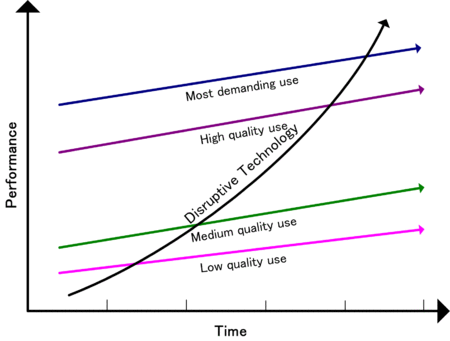
Image courtesy of Wikipedia. In this case, the disruptive technology is social media- what started out as quaint little toys became something that's helping to kill newspapers around the world.[/caption]
- Nobody really set out to invent social media. Facebook was meant to be a social networking site for college students. Twitter didn't even know what it wanted to be.
- Publishing was introduced to conventional communications, and people loved it. It gave us power that we never had before. It's made a lot of us kinda annoying. But that was just a cost of incredible functionality- we can now communicate peer-to-peer around the world, en-masse, instantaneously.
- It's hard to imagine this happening the other way around. It's quite telling that none of the traditional media establishments were involved in the development of any of the major social media platforms today.
Despite this, it would be naive to suggest that social media will completely kill off traditional media.
The lightbulb dealt a heavy blow to the candle industry, but we still have candles today- they're just not as ubiquitous as they used to be. Similarly, there will probably always be space for traditional media. They just won't enjoy the overwhelming authority that they used to. The golden age is past.
Let's return to the Mashable article:
"For many readers, Twitter is a headline service that drives them to traditional news outlets for deeper coverage," said Eric Kuhn, who ran social media for CNN before leaving to lead social at United Talent Agency. "That's why news outlets partnering up with Twitter is so powerful and makes so much sense."
- What's actually happening is a sort of reorganization of roles and responsibilities. A physical newspaper doesn't make very much sense anymore, now that smartphones and tablets are so ubiquitous. News no longer needs to follow the schedule of a printing press- it can break at any second.
- People do still value the authority and legitimacy of reputable news networks. There will always be room for quality insight, analysis and reporting.
So What? What are the implications?
When thinking about disruption:
- Disruption can happen in any industry, startlingly, swiftly. Here's a great TechCrunch article about disruption that you ought to read. Also, check out Clayton Christensen's book, The Innovator's Dilemma.
- Pay very, very careful attention to your users. If their behaviour changes, you'll have to adjust accordingly. Adapt or perish.
When thinking about dealing with media:
- Worry less about the "gatekeepers" and focus on pleasing customers. The power is yours, now more than ever before. Quality content almost inevitably rises to the surface with minimal distribution.
- You ought to have a blog, and a social media presence. It doesn't need to be superfantastic. What matters most is that your product is functional and solves a problem that real people have. Once you've got that, just be present and accessible.
- Everybody knows that content is king. The challenge is to dig deeper than anybody else. There's no secret sauce to that one. If you publish blueprints for the Hyperloop, you get free publicity for Tesla and SpaceX. But first come up with the Hyperloop blueprints.
_____
P.S. While researching this blogpost, I found a quote that validates our "social media is the convergence of communications and publishing" idea.
"With Twitter, it wasn't clear what it was. They called it a social network, they called it microblogging, but it was hard to define, because it didn't replace anything. There was this path of discovery with something like that, where over time you figure out what it is. Twitter actually changed from what we thought it was in the beginning, which we described as status updates and a social utility. It is that, in part, but the insight we eventually came to was Twitter was really more of an information network than it is a social network." - Evan Williams
This is entirely consistent with the idea that social networking sites become social media when they introduce publishing, allowing for content to percolate throughout the entire network.
This percolation is managed by specific features- which we'll explore in a following blogpost, because we're geeky like that. 8-)
Other posts in this sequence:
- What IS social media?
- Why is it so hard to define social media, and why should we care?
- What's the difference between 'social networking sites' and social media?
- Why are people so annoying on social media?
- How did online social networks disrupt traditional media?
- How will social media change the way we live and consume?
- How to navigate social media effectively
- Curated Social Media Wisdom From Top Enterprise Experts [Infographic]