Key Takeaways
- Klaviyo email flows are automated sequences triggered by customer behaviors that nurture relationships and drive revenue without manual intervention
- Essential flows include welcome series, abandoned cart recovery, post-purchase sequences, and browse abandonment—each serving specific customer journey stages
- Proper segmentation and personalization can increase email revenue by up to 760%, making strategic flow setup critical for ecommerce success
- Advanced flows like win-back campaigns and VIP nurture sequences transform one-time buyers into loyal advocates
- Regular testing and optimization of flow timing, content, and triggers ensures maximum performance and customer engagement
The Complete Guide to Klaviyo Email Flows Setup for Ecommerce Success
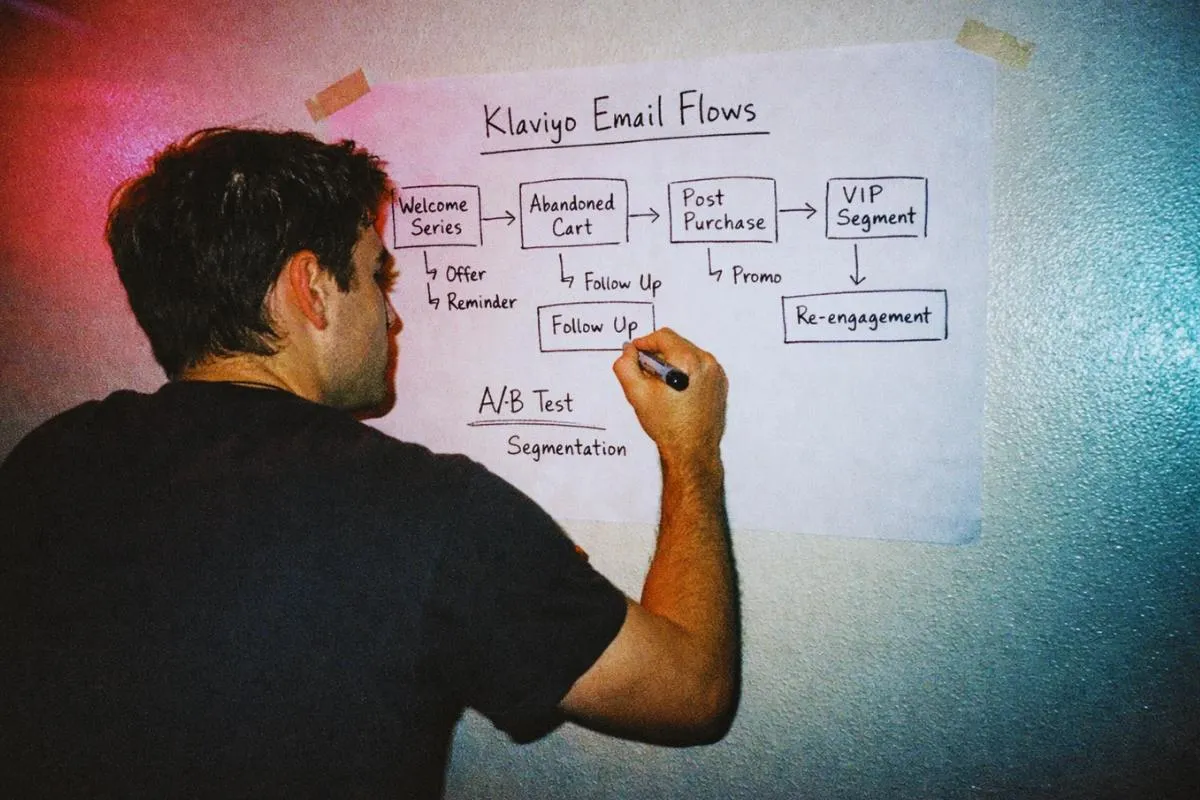
If you're running an ecommerce store, you already know that email marketing drives revenue. But manually sending emails to every customer at the perfect moment? That's impossible to scale. This is where Klaviyo email flows setup becomes your competitive advantage. Email flows are automated sequences that trigger based on customer behaviors, delivering the right message at precisely the right time—whether someone just subscribed to your list, abandoned their cart, or made their first purchase.
Setting up effective Klaviyo email flows transforms your email marketing from reactive to proactive. Instead of scrambling to engage customers manually, you'll build sophisticated automation that nurtures relationships, recovers lost sales, and turns first-time buyers into repeat customers. In this comprehensive guide, you'll learn how to set up every essential Klaviyo email flow your ecommerce business needs, from foundational welcome series to advanced customer retention sequences.
Understanding Klaviyo Email Flows: The Foundation of Automated Marketing
Before diving into specific flow setups, let's clarify what makes Klaviyo flows powerful. An email flow is an automated series of emails triggered by specific customer actions or conditions. Unlike campaigns that you send to your entire list at once, flows respond to individual customer behaviors in real-time.
Think of flows as your always-on sales team. When a customer abandons their cart at 2 AM, your abandoned cart flow sends a reminder within hours. When someone makes their first purchase, your post-purchase flow immediately begins building that relationship. This automation operates 24/7, ensuring no customer interaction goes unnoticed.
Why Klaviyo Email Flows Outperform Traditional Campaigns
The data speaks for itself: automated email flows generate significantly higher open rates, click-through rates, and revenue per recipient compared to broadcast campaigns. This performance difference stems from relevance and timing. Flow emails arrive when customers are actively thinking about your brand, making them exponentially more effective.
Klaviyo's platform excels at flow creation because it combines powerful segmentation with behavioral triggers. You can create flows that respond to browsing behavior, purchase history, email engagement, and even predictive analytics about future customer actions. This level of sophistication enables personalization that feels genuinely helpful rather than invasively automated.
Essential Klaviyo Email Flows Every Ecommerce Store Needs
While you could create dozens of specialized flows, certain sequences form the foundation of successful ecommerce email marketing. These essential flows address critical customer journey moments and deliver the highest return on investment for your setup effort.
Welcome Series Flow: Making Powerful First Impressions
Your welcome series is often the first meaningful interaction customers have with your brand after subscribing. This flow typically generates the highest engagement rates of any sequence—subscribers expect to hear from you and are actively interested in your products.
To set up an effective welcome flow in Klaviyo, start by creating a new flow and selecting "List" as your trigger. Configure it to trigger when someone subscribes to your main email list. Your welcome series should include 3-5 emails spaced over 7-14 days:
- Email 1 (Immediate): Thank subscribers, set expectations, and deliver any promised discount code
- Email 2 (Day 2-3): Share your brand story and what makes you different
- Email 3 (Day 5-7): Showcase bestselling products or customer favorites
- Curated product showcases perform well in welcome flows. For inspiration on how to present products compellingly, see how we highlighted the coolest products of 2025.
- Email 4 (Day 10-14): Provide educational content or usage tips
The key to welcome flow success is balancing promotional content with value-driven information. New subscribers aren't ready for hard selling—they're evaluating whether your brand deserves their attention. Building a strong customer retention foundation starts with this first impression.
Abandoned Cart Flow: Recovering Lost Revenue
Abandoned cart flows represent one of the highest-ROI automations you can implement. With average cart abandonment rates hovering around 70%, recovering even a fraction of these lost sales significantly impacts revenue.
Setting up your Klaviyo abandoned cart flow requires configuring the "Checkout Started" trigger. This metric fires when someone adds items to their cart and begins checkout but doesn't complete the purchase. Configure your flow with these timing considerations:
- Email 1 (1-4 hours): Simple reminder with cart contents and clear checkout link
- Email 2 (24 hours): Address common objections, highlight free shipping or guarantees
- Email 3 (48-72 hours): Create urgency with limited-time discount or scarcity messaging
Advanced abandoned cart flows incorporate dynamic product recommendations, showing items similar to what customers left behind. You can also add conditional splits based on cart value—offering larger incentives for high-value carts while maintaining margins on smaller purchases.
Post-Purchase Flow: Building Customer Loyalty
The moment after purchase is critical for relationship building. Your post-purchase flow should confirm the transaction, set delivery expectations, and begin nurturing customers toward their next purchase.
Configure this flow using the "Placed Order" trigger in Klaviyo. Your sequence should address both immediate post-purchase needs and longer-term engagement:
- Email 1 (Immediate): Order confirmation with details and tracking information
- Email 2 (Delivery day): Delivery notification and product usage tips
- Email 3 (3-7 days post-delivery): Request review or feedback
- Email 4 (14-30 days): Cross-sell complementary products
This flow is also perfect for introducing customers to your referral program, encouraging them to share their positive experience with friends. Timing this invitation after they've received and enjoyed their purchase maximizes participation rates.
Browse Abandonment Flow: Capturing Early-Stage Interest
Browse abandonment flows target customers who viewed products but didn't add anything to their cart. These visitors demonstrated interest but need additional nurturing to convert.
Set up this flow using Klaviyo's "Viewed Product" metric as your trigger. For traffic from visual discovery platforms, browse abandonment flows are especially powerful—shoppers from Pinterest affiliate marketing campaigns often browse extensively before purchasing, making timely follow-up emails critical. Add filters to exclude people who subsequently added items to cart or made purchases. Your browse abandonment sequence should be shorter and softer than cart abandonment:
- Email 1 (4-24 hours): Showcase the viewed product with social proof
- Email 2 (48 hours): Provide additional product information or customer reviews
Keep this flow concise—browsers are earlier in their journey and may not be ready for aggressive remarketing. Focus on providing helpful information rather than pushing for immediate conversion.
Advanced Klaviyo Flow Strategies for Maximum Impact
Once you've implemented essential flows, these advanced strategies help you extract even more value from your email automation. These flows target specific customer segments and lifecycle stages for highly personalized engagement.
Win-Back Flow: Re-engaging Dormant Customers
Customer win-back flows target people who previously purchased but haven't engaged recently. This automation is crucial for maintaining a healthy customer base and maximizing lifetime value.
Create a segment in Klaviyo defining "at-risk" customers—typically those who haven't purchased in 60-90 days (adjust based on your typical purchase frequency). Use this segment as your flow trigger with these components:
- Email 1: "We miss you" message with personalized product recommendations
- Email 2: Special comeback offer or exclusive discount
- Email 3: Survey asking why they stopped purchasing (valuable feedback)
- Email 4: Last-chance offer before removing from active marketing
Win-back flows demonstrate respect for customer preferences. If someone doesn't re-engage after your sequence, consider suppressing them from regular campaigns to maintain list health and deliverability.
VIP Customer Flow: Rewarding Your Best Customers
Your top customers deserve special treatment. VIP flows recognize high-value customers and strengthen their loyalty through exclusive perks and personalized attention.
Define your VIP segment using Klaviyo's predictive analytics or custom metrics—perhaps customers who've spent over a certain threshold or made multiple purchases. Your VIP flow should make these customers feel genuinely valued:
- Email 1: VIP status announcement with exclusive benefits
- Email 2: Early access to new products or sales
- Email 3: Birthday or anniversary recognition with special offer
- Ongoing: Regular exclusive content or behind-the-scenes updates
VIP customers are also your best candidates for word-of-mouth marketing initiatives. They're already passionate about your brand and more likely to recommend you to their networks.
Replenishment Flow: Anticipating Customer Needs
For consumable products, replenishment flows remind customers to reorder before they run out. This proactive approach increases customer convenience while driving predictable revenue.
Calculate your product's typical usage period, then set up a flow triggered X days after purchase. For example, if customers typically need to reorder skincare products every 60 days, trigger your replenishment flow at day 50:
- Email 1 (Day 50): Gentle reminder that they're likely running low
- Email 2 (Day 60): Direct reorder prompt with one-click purchase link
- Email 3 (Day 70): Last reminder with potential incentive
Klaviyo's product-specific triggers make this flow particularly powerful. You can customize timing for different products and even use predictive analytics to refine reorder windows based on individual customer behavior.
Optimizing Your Klaviyo Email Flow Performance
Setting up flows is just the beginning. Continuous optimization ensures your automations perform at their peak and adapt to changing customer behaviors.
A/B Testing Flow Components
Klaviyo's built-in A/B testing capabilities let you experiment with different elements of your flows. Test these high-impact variables:
- Subject lines: Test different hooks, personalization, and urgency levels
- Send timing: Experiment with delay intervals between emails
- Discount depths: Find the minimum incentive needed to drive conversions
- Content approaches: Compare educational versus promotional messaging
- Call-to-action placement: Test button position and copy variations
Run tests long enough to achieve statistical significance—typically at least 1,000 recipients per variant. Small sample sizes can lead to misleading results and poor optimization decisions.
Monitoring Flow Analytics
Regularly review your flow performance metrics in Klaviyo's analytics dashboard. Key metrics to track include:
- Open rates: Indicates subject line effectiveness and sender reputation
- Click-through rates: Measures content relevance and engagement
- Conversion rates: Shows how effectively flows drive desired actions
- Revenue per recipient: Quantifies financial impact of each flow
- Unsubscribe rates: Signals potential issues with frequency or relevance
Set up regular review cadences—monthly for high-volume flows, quarterly for lower-volume sequences. Look for trends rather than reacting to short-term fluctuations. Staying current on email marketing best practices helps you spot optimization opportunities—check out the top Shopify newsletters for DTC brands for ongoing tactical insights.
Segmentation and Personalization Best Practices
Klaviyo's segmentation capabilities enable sophisticated personalization that dramatically improves flow performance. Move beyond basic first-name personalization to include:
- Product recommendations: Use browsing and purchase history to suggest relevant items
- Geographic personalization: Reference local events, weather, or shipping times
- Behavioral triggers: Adjust messaging based on engagement patterns
- Predictive segments: Leverage Klaviyo's AI to identify high-value customers early
The most effective flows feel like one-to-one conversations rather than mass marketing. Every personalization element should add genuine value, not just demonstrate that you're tracking customer data.
Technical Setup Considerations for Klaviyo Flows
Proper technical configuration ensures your flows trigger correctly and deliver optimal results. These setup details might seem minor but significantly impact performance.
Flow Filters and Conditional Splits
Flow filters prevent emails from sending to inappropriate recipients. Common filters include:
- Exclude customers who've already purchased (for abandoned cart flows)
- Suppress recipients who've received the email previously
- Filter out email addresses with low engagement scores
- Exclude VIP customers from general promotional flows
Conditional splits create branching logic within flows. For example, split your post-purchase flow based on product category—customers who bought skincare receive different follow-up content than those who purchased supplements.
Smart Sending and Frequency Caps
Klaviyo's Smart Sending feature prevents customers from receiving multiple emails within a specified timeframe. Enable this to avoid overwhelming subscribers when they trigger multiple flows simultaneously.
Configure Smart Sending with these considerations:
- Set appropriate time windows (typically 16-24 hours between emails)
- Prioritize high-value flows (abandoned cart over browse abandonment)
- Exclude time-sensitive transactional emails from Smart Sending
- Monitor how often Smart Sending suppresses messages
Balance automation efficiency with subscriber experience. Even perfectly relevant emails become annoying at excessive frequencies.
Integration with Your Ecommerce Platform
Klaviyo integrates with major ecommerce platforms including Shopify, WooCommerce, Magento, and BigCommerce. Proper integration ensures accurate data flow and trigger reliability.
Verify these integration elements:
- Product catalog syncing correctly with current inventory
- Order data flowing in real-time for transactional flows
- Custom properties tracking properly for advanced segmentation
- Abandoned cart tracking capturing all checkout abandonment events
Test your flows thoroughly before launching. Place test orders, abandon test carts, and browse products while logged into test accounts to ensure triggers fire correctly.
Common Klaviyo Flow Setup Mistakes to Avoid
Even experienced marketers make these flow setup errors. Avoiding these pitfalls saves time and preserves customer relationships.
Over-Automation and Email Fatigue
The biggest mistake is implementing too many flows without considering cumulative email volume. A customer could theoretically receive welcome emails, browse abandonment emails, cart abandonment emails, and post-purchase emails all within a few days.
Prevent fatigue by mapping the complete customer journey and identifying potential overlap. Use Smart Sending strategically and monitor unsubscribe rates closely as you add new flows.
Generic, Impersonal Content
Automated doesn't mean robotic. Flows that feel mass-produced underperform compared to those that leverage Klaviyo's personalization capabilities.
Invest time in writing compelling, personalized copy for each flow email. Use dynamic content blocks to customize messaging based on customer attributes. Reference specific products customers viewed or purchased to create relevance.
Neglecting Mobile Optimization
Over 60% of emails are opened on mobile devices. Flows that aren't mobile-optimized frustrate customers and tank conversion rates.
Ensure your Klaviyo templates are responsive, use large touch-friendly buttons, and display properly across devices. Test every flow email on multiple screen sizes before activation. For more tactical ecommerce insights you can absorb while multitasking, explore the best Shopify podcasts for DTC brands.
Ignoring Flow Maintenance
Flows aren't "set and forget" automations. Products change, seasonal promotions shift, and customer preferences evolve. Flows that reference discontinued products or outdated offers damage credibility.
Schedule quarterly flow audits to update product references, refresh creative elements, and remove outdated messaging. Keep flows current and aligned with your overall marketing strategy.
Frequently Asked Questions
How many Klaviyo email flows should I start with as a new ecommerce store?
Start with three essential flows: welcome series, abandoned cart, and post-purchase. These foundational automations address the most critical customer journey moments and deliver the highest ROI with minimal setup complexity. Once these flows are running smoothly and you've optimized their performance, expand to browse abandonment and win-back flows. Attempting to implement too many flows simultaneously often results in poorly configured automations that underperform.
What's the ideal timing between emails in a Klaviyo flow?
Timing depends on the specific flow and customer urgency. For abandoned cart flows, send the first email within 1-4 hours while intent is fresh, followed by emails at 24 and 48-72 hours. Welcome series emails work well spaced 2-3 days apart over two weeks. Post-purchase flows should align with product delivery and usage timelines. Always test different timing intervals—your specific audience may respond better to compressed or extended sequences based on your product type and purchase cycle.
Should I offer discounts in my Klaviyo abandoned cart flow?
Not necessarily in the first email. Many customers abandon carts due to distractions rather than price concerns. Your first abandoned cart email should simply remind customers about their items and address common objections like shipping costs or return policies. Reserve discount offers for the second or third email, and consider using conditional splits to offer incentives only for high-value carts. This approach maximizes revenue by converting price-insensitive customers at full margin while still recovering price-sensitive shoppers.
How do I prevent customers from receiving too many automated emails from different Klaviyo flows?
Use Klaviyo's Smart Sending feature to set minimum time intervals between emails (typically 16-24 hours). Create flow filters that exclude customers who recently received emails from other flows. Implement a frequency cap at the account level to limit total emails per week. Map your complete customer journey to identify potential flow overlaps, then prioritize which flows should take precedence when triggers overlap. Regularly monitor the "Skipped" metric in flow analytics to understand how often Smart Sending is suppressing messages.
What metrics should I track to measure Klaviyo flow success?
Focus on revenue per recipient as your primary success metric—it directly ties flow performance to business impact. Also monitor open rates (subject line effectiveness), click-through rates (content engagement), conversion rates (persuasiveness), and placed order rates (revenue generation). Track these metrics both at the flow level and for individual emails within flows. Compare flow performance against your broadcast campaigns to quantify automation value. Set up custom Klaviyo dashboards that display these metrics in real-time for quick performance assessment.
Can I use Klaviyo flows to reduce customer acquisition costs?
Absolutely. Well-optimized flows increase customer lifetime value, which allows you to spend more on acquisition while maintaining profitability. Post-purchase flows that drive repeat purchases, VIP flows that increase order frequency, and win-back flows that reactivate dormant customers all improve retention metrics. Higher retention means each acquired customer generates more revenue over time. Additionally, flows that encourage referrals and word-of-mouth marketing create acquisition channels with minimal ongoing costs, compounding the value of your existing customer base.
How often should I update and optimize my Klaviyo email flows?
Review high-volume flows (welcome, abandoned cart, post-purchase) monthly to identify optimization opportunities. Conduct quarterly comprehensive audits of all flows to update product references, refresh creative assets, and remove outdated messaging. Run A/B tests continuously on subject lines, send timing, and content approaches—implement winning variations as soon as statistical significance is reached. Major flow overhauls should happen annually or when you launch new products, rebrand, or significantly shift your marketing strategy. Treat flows as living assets that require ongoing attention rather than one-time setup projects.
What's the difference between Klaviyo flows and campaigns, and when should I use each?
Flows are automated sequences triggered by customer behaviors (browsing, purchasing, abandoning carts), while campaigns are one-time broadcasts sent to segments of your list. Use flows for behavioral responses and lifecycle marketing—they run continuously and respond to individual customer actions. Use campaigns for time-sensitive promotions, product launches, seasonal sales, and company announcements that apply to your entire audience. The most effective email strategies combine both: flows nurture individual customer relationships while campaigns create excitement around specific events and offers.
Conclusion: Transform Your Ecommerce Email Marketing with Strategic Klaviyo Flow Setup
Klaviyo email flows setup represents one of the highest-leverage activities in your ecommerce marketing toolkit. By automating personalized customer communications at critical journey moments, you create a scalable system that drives revenue 24/7 without constant manual intervention. The flows outlined in this guide—from foundational welcome series to advanced VIP nurture sequences—form a comprehensive automation strategy that addresses every stage of the customer lifecycle.
Remember that successful flow implementation is iterative. Start with essential flows, monitor their performance closely, and optimize based on real customer data. As you gain confidence and see results, expand to more sophisticated automations that leverage Klaviyo's advanced segmentation and personalization capabilities. The investment you make in thoughtful flow setup pays dividends through increased customer lifetime value, higher conversion rates, and stronger brand relationships.
Ready to take your email marketing to the next level? Start by implementing your first Klaviyo flow today—your welcome series is the perfect place to begin. As you build momentum with automation, you'll free up time to focus on strategic growth initiatives while your flows work tirelessly to engage customers, recover sales, and build lasting loyalty. The future of ecommerce belongs to brands that master personalized automation, and with Klaviyo flows, you have everything you need to compete and win.