
During a recent sales call with a client (do you want to talk to me?) I was asked how many reward tiers give a referral program the best results.
If there’s one thing I value in life is honesty, so I said that I honestly didn’t know, but that their question was so good that it was worth studying it.
And here I am.
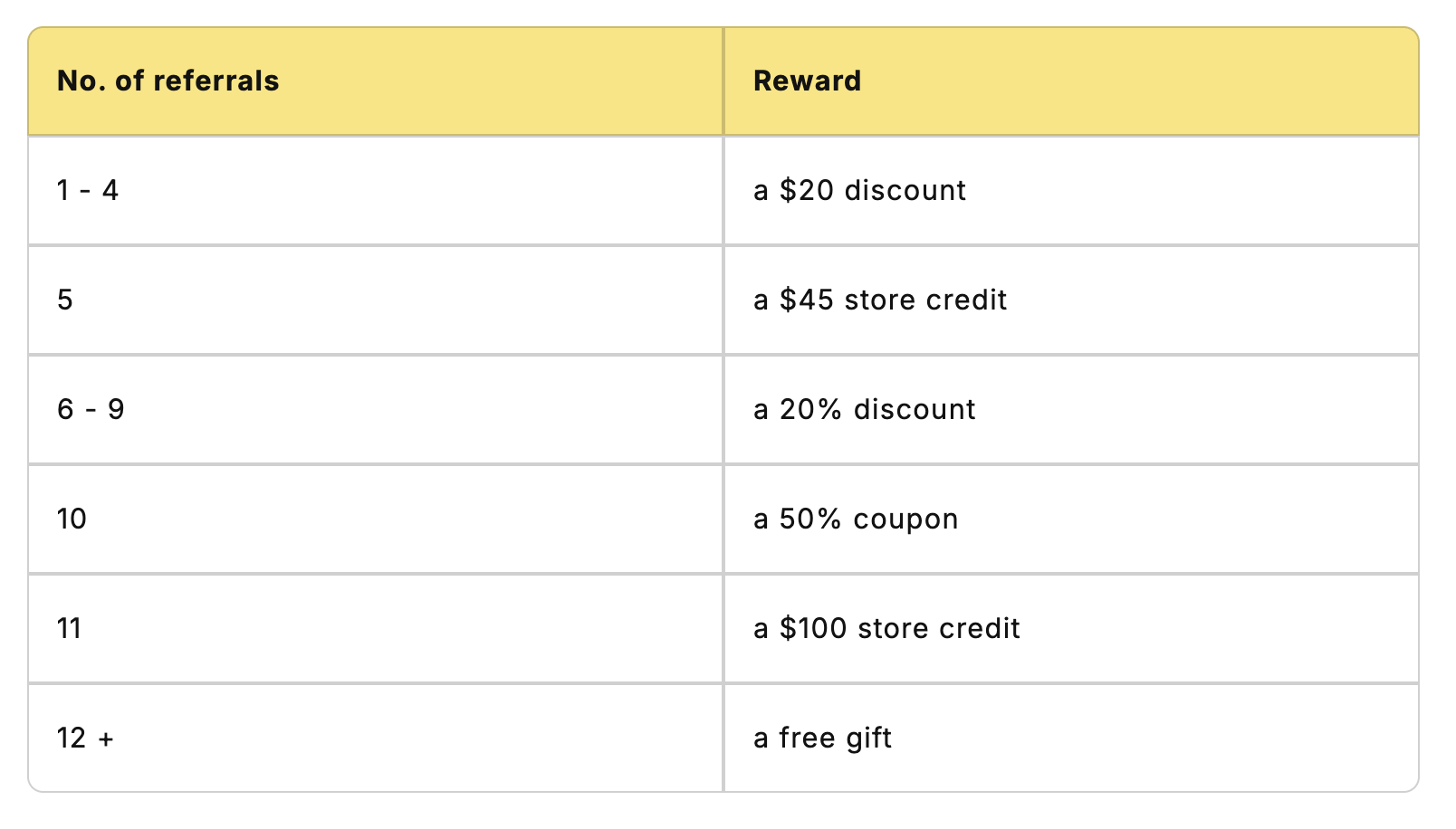
I went to the one place I always go whenever I’m wondering about how ecommerce merchants behave, which is our own ReferralCandy’s merchant data. I honestly didn’t expect that big of a difference but I was shocked to learn that programs with two or three reward levels showed about 30% more sharing activity per new member than programs with one level!
This alone should put the question to rest. Launching a simple “Give $20, Get $20”, simple referral program is unfortunately one way to make your program not attractive enough for your customers and partners.
Let’s break this down.
What I counted as sharing
I looked at how often new program members clicked a share button or copied their referral link during their first 30 days. ReferralCandy’s referral program share buttons include options such as WhatsApp, Facebook, Telegram, Threads and email. I called each click or link copy a sharing action.
Then, for each store, I added up those actions and divided them by the number of new members. People who took no sharing action still counted as members (or non-sharing members). This let us compare stores with different numbers of people in their programs.
I then put each group’s stores in order by their score and compared the middle of the two groups (this middle value is called the median –my college stats professor would be proud), and it means that a few unusually busy stores have less effect on this comparison than they would on an average.
Now I’m not going to pretend to fool you or fool myself here: clicking a share button doesn’t necessarily prove a message was sent. Copying a link doesn’t also necessarily prove a friend received it, but I’m assuming that these shares happened because otherwise why would a customer click the link – whether the friend ended up leaving them on read (rude).
What the comparison showed
The 30% finding I mentioned earlier comes from new members added to Shopify referral programs during the month of August 2026. I actually followed each member for 30 days (from a distance). The programs had one referral reward tier or two and up to three reward levels, with no recorded changes to those tiers during the study period.
The main finding is that advocates who joined a referral or affiliate program with two or three tiers shared 30% more than those who were part of a single-tier referral or affiliate program.
Here is a made-up example to explain the percentage:
Imagine two different online stores (SweetStitch and SweetSupplements) each add 1,000 new advocates to their referral program. SweetStitch records 100 sharing actions and SweetSupplements records 130. That is how the 30% more sharing activity for the same number of members looks like.
For a merchant, more sharing activity is an early positive sign to investigate and encourage. The result from this experiment depends on whether friends go on to buy and whether those orders justify the reward cost. Here’s how I’d approach a test.
Choose the one thing you want to improve in your program
Start with what people do in your referral or affiliate program today, and that will help you decide what the next reward should encourage.
If few customers share, first check whether they can find the offer and understand how to use their link. You’ll be surprised how many referral programs underperform simply because customers barely see the program itself.
If customers share but few friends buy, look at the friend’s offer and buying experience. More sharing alone won’t tell you whether that problem has improved.
If customers bring in one friend and then stop, a reward for reaching the next milestone is a useful test you can run. You have a clear action to encourage: bringing in another new customer, so you can track that action separately from repeat orders placed by the first friend.
Choose one main result before you change the rewards. And don’t forget to troubleshoot your program – how easy is it to find the link? And share? Did you set up the correct email flows and touchpoints? At the end of the day, you can watch several numbers, but decide which one will tell you whether the test worked.
Start with one clear next objective
If your referral or affiliate program currently offers only one reward level and want to test additional tiers, I’d start by adding one more. That gives you a simple setup to explain, price and review, as well as a starting point for an experiment.
Here is an example of a two-level test:
| Reward level | When it starts | What the customer earns |
|---|---|---|
| First level | Their first successful referral | Your current reward |
| Second level | Their second successful referral | A higher reward that fits your budget |
If your goal is new customers, set your reward conditions to count only a friend’s first purchase, this will keep repeat orders from the same friend from earning more rewards in the test.
For this example, you could keep giving the second-level reward for later successful referrals. Our feature FlexiTiers lets you choose whether rewards continue after the last tier, stop, or start again from the first tier. You can check how past rewards count toward the new levels before launch in the FlexiTiers setup guide.
The milestone and reward still need to fit your store, product and margin. A reward after the next referral and a reward much further away ask different things of your customers, even if both programs have two levels.
Work through the cost before you choose the higher reward. And what I mean is: Include the reward to the person referring, the friend’s discount, and the costs of filling the order, because more referral sales can still leave you with less money if the offer costs too much.
Then write down the offer in a sentence a customer can understand and is able to repeat right after reading it: what they need to do, what they earn next, and what happens after that. If the explanation is not easily understood in one sentence, simplify the setup before adding more levels.
Give customers a next step worth testing
If you’re ready to try out a multiple reward structure for your referral or affiliate program, open the FlexiTiers setup guide, choose the next milestone, and record your current results before you launch. Then see how your customers react to it and let that guide the next change.