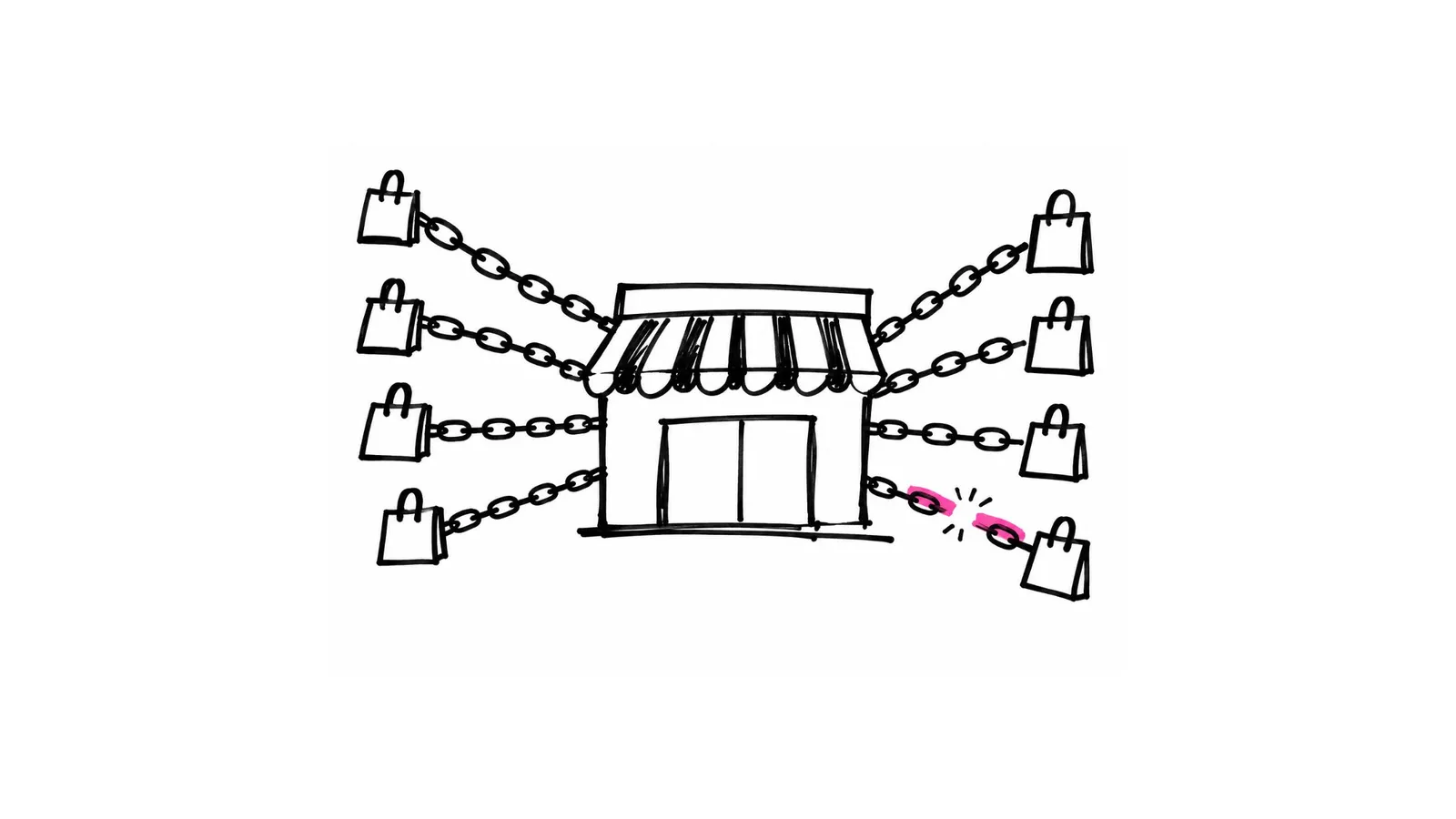
Most merchants would rather recruit five perfect creators than manage fifty average ones. The instinct is reasonable. A small roster is easier to brief, easier to support, and easier to know by name.
It is also fragile. One creator gets busy, another posts twice and moves on, and suddenly the program has nobody left carrying it. Affiliate growth is partly a relationship problem and partly a portfolio problem. The data shows where one starts to become the other.
We studied more than 130 live Shopify merchants with a current active affiliate campaign and at least one enrolled partner. The measurement window covers the twelve completed months from July 2025 through June 2026. We counted distinct, non-disqualified customers referred through affiliate campaigns, then compared four roster bands.
Five affiliates leave too much to chance
We looked at whether each affiliate program referred at least one customer during the study period. Programs with larger rosters were consistently more likely to do so.
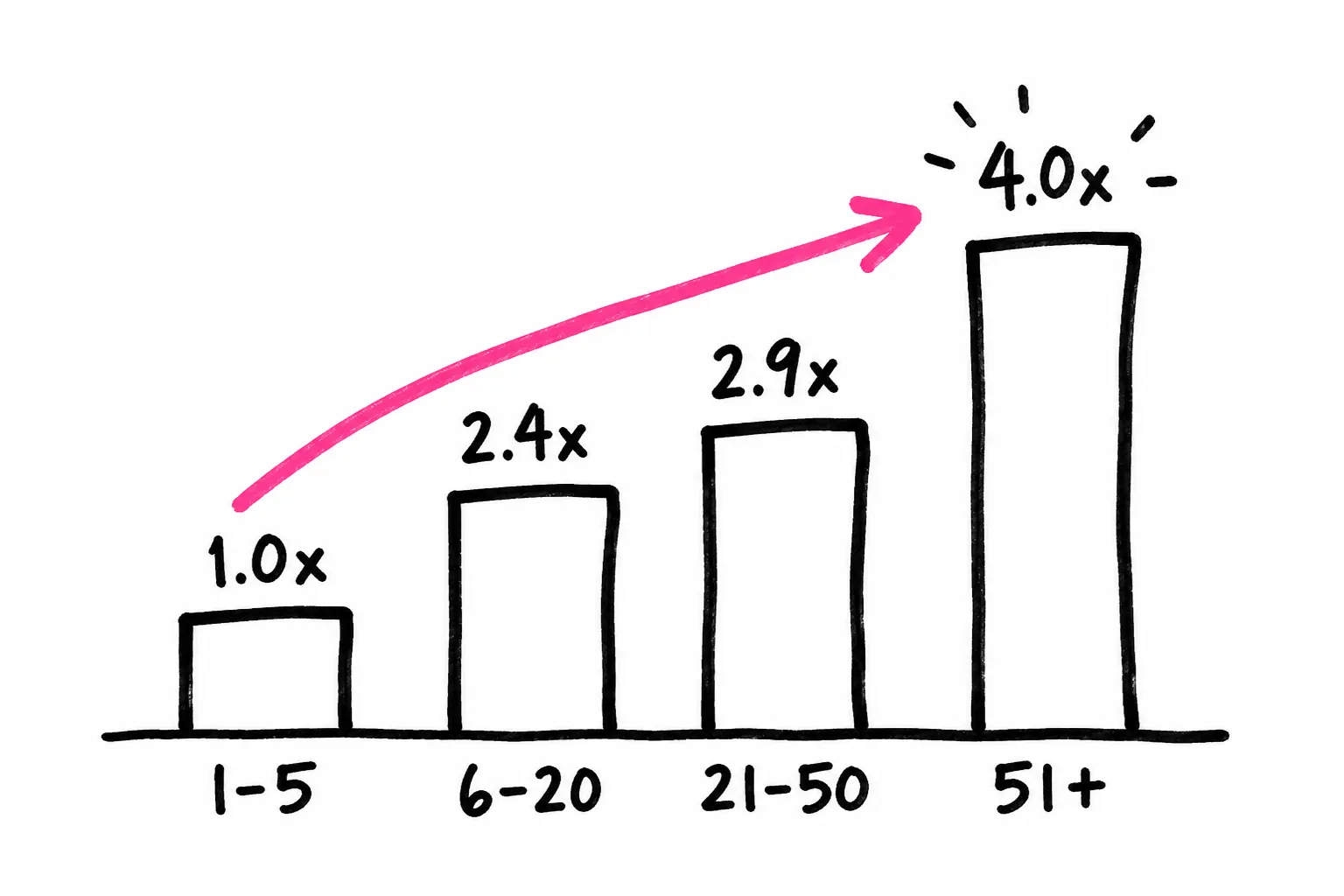
To compare the groups without publishing private merchant benchmarks, we used programs with one to five affiliates as the reference point. A 2.4x result means that programs with 6–20 affiliates were 2.4 times as likely to refer at least one customer as programs with 1–5 affiliates. It does not mean they acquired 2.4 times as many customers.
1–5 affiliates
- Likelihood of referring at least one customer: Reference point
6–20 affiliates
- Compared with programs with 1–5 affiliates: 2.4x as likely
21–50 affiliates
- Compared with programs with 1–5 affiliates: 2.9x as likely
51+ affiliates
- Compared with programs with 1–5 affiliates: 4.0x as likely
This is the portfolio effect in plain clothes. Every affiliate is uncertain, even when the fit looks perfect. A deeper roster gives the program more chances to find the partners whose audience, timing, and willingness to keep promoting line up.
The gain was not limited to whether a program produced anything at all. The median referred-customer count for rosters above fifty was 23 times that of the 21–50 group and 69 times that of the 6–20 group. More partners did not merely rescue a few silent programs. At the median, they changed the scale of the channel.
A bigger roster also carries more passengers
Total output and partner efficiency moved in opposite directions. Programs with 6–20 enrolled affiliates produced 8.5 times more referred customers per affiliate at the median than programs with more than fifty.
That does not make the smaller roster better. It shows what happens as recruitment broadens. The first partners are usually chosen with care: people who already know the product, creators with a tightly matched audience, customers who keep recommending the brand without much prompting. Later recruitment reaches further. The roster becomes more dependable as a whole, while the average relationship becomes less productive.
The practical mistake is choosing one metric and ignoring the other. Optimizing only for roster size creates a large database of quiet accounts. Optimizing only for output per partner can leave the entire program dependent on a handful of people.
Build depth in two stages
The data suggests a cleaner operating sequence.
First, move beyond the one-to-five stage. Recruit enough well-matched partners that one person disappearing does not shut down the channel. A roster of 6–20 is still small enough for personal onboarding and direct feedback, and it showed far stronger partner-level efficiency than the largest programs in the study.
Then expand once the relationship model works. Keep the brief clear, make links and codes easy to use, and notice which kinds of partners keep producing after the first promotion. Larger rosters improve reliability, but only a repeatable way to recruit and support people turns that reliability into growth.
This is observational data, not proof that adding affiliates causes the lift. Strong programs can attract more partners, and the roster snapshot reflects merchants active when we ran the study. Even so, the progression is too orderly to ignore: tiny rosters were brittle, mid-sized rosters were efficient, and the largest rosters were the most dependable.
The useful target is not a magical headcount. Recruit until the program no longer depends on one creator, then manage the roster closely enough that growth does not come at the cost of every relationship inside it.